The Social Media Trap Few Parents Talk About
Perhaps the greatest challenge facing modern parents isn't a lack of information. It's the sheer volume of inspiration. Every day we are exposed to beautifully curated play spaces and carefully photographed collections. Many of these spaces are genuinely inspiring. Some introduce families to toys and philosophies they may never have discovered otherwise. Some provide wonderful ideas. But there is also a hidden cost.
Comparison.
At My Happy Helpers, we've spoken with countless parents who quietly worry they aren't providing enough. Not because their children are unhappy. Not because play isn't happening. But because social media has created a picture of what open-ended play is supposed to look like. Perfect shelves. Matching collections. Beautifully styled spaces. Yet when we step back and observe the children themselves, the picture often looks very different.
The children are not comparing collections. They are not evaluating aesthetics. They are not wondering whether a rainbow matches a loose parts tray.
They are simply playing.
Sometimes the pressure exists entirely in the adult world. Not the child's.
The Most Inspiring Play Spaces We've Ever Seen
Over the years, we've had the privilege of seeing thousands of play spaces. Some have been large. Some have been small. Some have contained extensive collections. Others have contained only a few carefully chosen pieces. What consistently stands out isn't the size of the collection.
It's the quality of the engagement.
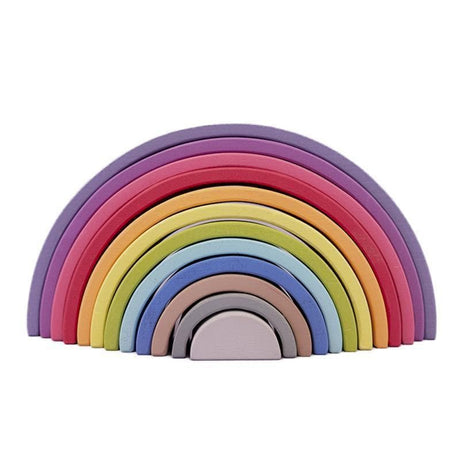
Some of the richest play we've ever witnessed happened with remarkably little. A rainbow. A block set. A handful of loose parts. A cardboard box. A blanket draped over a table. A child. That's often enough.
Because open-ended play isn't created by quantity. It's created by possibility. Children don't need endless options. They need meaningful ones.
What We Hope The Future Of Open-Ended Play Looks Like
At My Happy Helpers, we hope the future of open-ended play becomes more accessible. More inclusive. Less intimidating. Less focused on perfection. And more focused on children.
We hope families continue valuing quality, safety and thoughtful design. We hope businesses continue raising standards. We hope beautiful toys continue to exist. But we also hope parents never feel excluded from open-ended play because of budget, branding or social media expectations. Because open-ended play was never designed to be exclusive. It was designed to be universal.
It belongs to the child building with a handcrafted wooden rainbow. It belongs to the child building with a cardboard box from the recycling bin. It belongs to the child creating entire worlds from objects adults no longer notice. The materials may differ. The imagination does not.
What We Hope Parents Remember
If there is one thing we've learned through years spent developing products, working with educators and watching children play, it is this:
Children are far less impressed by toys than adults are. They are impressed by possibilities. The cardboard box becomes a rocket. The blanket becomes a cubby house. The stick becomes a magic wand. The rainbow becomes a bridge. The toy matters. Quality matters. Safety matters. Thoughtful design matters. But the imagination was already there. The toy simply gave it somewhere to go.
And perhaps that's the most important thing to remember when conversations about open-ended play become focused on brands, collections or price tags. The most valuable part was never something that could be purchased. It was the child all along.
That is why open-ended play doesn't belong to luxury brands. It never did. It belongs to every child fortunate enough to be given the freedom to imagine.