
Click & Collect or 24hr Dispatch*

Build & Construct · Building Blocks

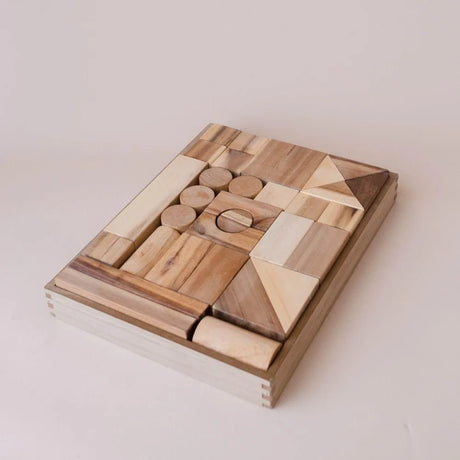
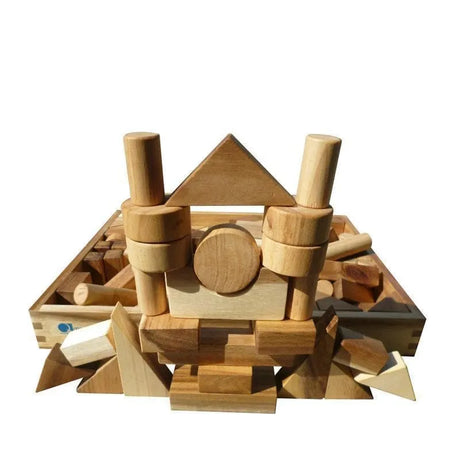
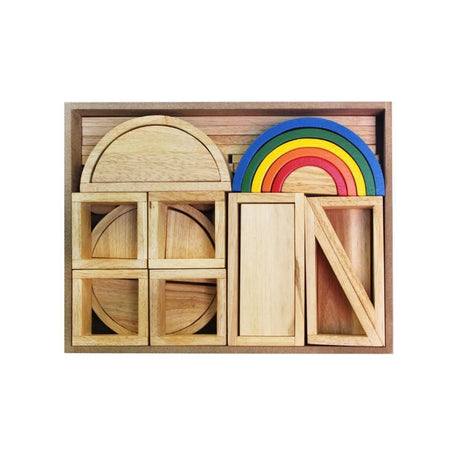
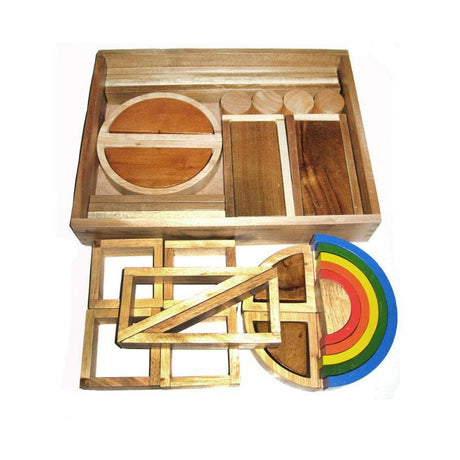
Big Wooden Blocks & Large Block Sets

Parents almost never buy big blocks because they want bigger blocks. They buy them because they want their child to build something they can step into. Small blocks build objects; big blocks build environments — and that's a completely different thing. A small-block castle is something a child admires. A big-block castle is somewhere they become the king, the dragon, the shopkeeper or the explorer. These large wooden block sets are about one quiet, powerful idea: come inside.


Why Big Blocks Build Places, Not Just Towers

Most shops describe large block sets as "perfect for larger constructions." But parents don't think in terms of construction — they think "will my child finally build something they can actually play inside?" That's the distinction that matters, and it's the moment families describe again and again: when the blocks stop being something a child stacks and become somewhere a child goes. With smaller wooden blocks, children usually finish building and then begin pretending. With big blocks, the build itself becomes the environment — they're immediately sitting inside it, crawling through it, hiding behind it, serving food from it and defending it from dinosaurs.

As one parent put it, "the castle wasn't the toy — the castle became where all the play happened for the rest of the afternoon." That's the whole appeal of oversized blocks: once a child has pieces they can walk around, they stop building objects and start designing places — airports, cafés, cubbies, hospitals, train stations, whole neighbourhoods. These are all-wooden big block sets, made to be dragged, stacked, sat on and rebuilt, and the recurring phrase in parent reviews isn't "they learned engineering" — it's "they never seem to run out of ideas," and "it became the centre of the room."

Big Blocks Build Environments Step Inside & Play Cooperative Building

Big Blocks Children Build to Step Inside

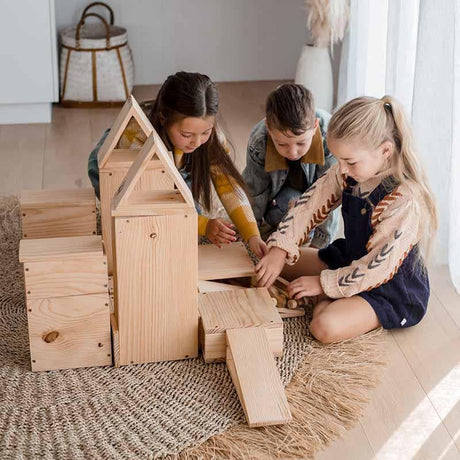
The single biggest difference parents notice with big blocks is that the build doesn't end with the build. A small-block creation is finished and then admired; a big-block creation is finished and then lived in. Children immediately start sitting inside, crawling through, hiding behind, driving around and defending it — the structure isn't the toy, it's where the play happens for the rest of the afternoon. That's because big blocks are built for a different scale entirely: not for cars, animals and peg dolls, but for the child's own body.

Watch and you'll hear the questions change. Small blocks prompt "how do I make this taller?"; big blocks prompt "can I fit through? can I crawl underneath? can I sit here?" Children start designing for people rather than toys, noticing that the doorway isn't tall enough or the tunnel's too narrow — genuinely architectural thinking. It's also one of the few construction toys that gets children moving: lifting, carrying, balancing, climbing around their builds, so gross-motor play becomes part of the fun rather than something separate. And because the structure is meant to be touched, parents stop saying "don't touch it" — the build isn't precious, it's alive.

The Big Block Set Siblings Finally Build Together

If smaller construction toys turn competitive in your house — everyone wanting the same special piece — big blocks tend to do the opposite. The project is simply too large for one child to finish alone, so the work naturally divides: one child builds the walls, another designs the entrances, someone gathers extra pieces, someone becomes the "architect." Parents with more than one child describe this constantly, and it's one of the strongest reasons they recommend large sets — cooperative building happens on its own, without an adult assigning roles.

In fact, big block play quietly reveals different personalities: the planner, the builder, the tester, the storyteller all emerge as a group brings a structure to life. And it spreads beautifully — the blocks connect to the sofa, the coffee table, dining chairs, a building board or a wooden rainbow, until the room itself becomes part of the construction. As one parent joked, "we didn't buy a block set, we accidentally renovated our lounge room." That whole-room, whole-family quality is exactly what makes big blocks the centre of so much play.

Big Blocks That Become a Whole Neighbourhood (and Stay Up for Days)

Big block projects tend to last — not because they're a chore to pack away, but because children keep coming back to them. Today it's a castle; tomorrow the castle gets another room; the day after it's a veterinary clinic. The project evolves rather than being rebuilt from scratch, which is part of why parents describe big blocks becoming part of everyday play rather than a novelty that's exciting once. Children also stop building single structures and start creating communities — streets, parks, schools, hospitals, farms and shops — thinking about how spaces connect. "She didn't build a house," one parent said, "she built a whole neighbourhood."

This is also the answer to the question parents most often ask: won't they outgrow them quickly? Families overwhelmingly say the opposite. A two-year-old builds walls; a six-year-old designs multi-room villages — the same set simply grows more sophisticated with the child, which is why "are they worth the extra money?" is almost always answered with longevity rather than quality. Pair big blocks with building boards, loose parts and wooden rainbows and the worlds get bigger still — connected, inhabitable places a child returns to day after day.
Shop by need
Unit Blocks - 20pcs

Big Blocks vs Small Blocks: Which Does Your Child Need?

Neither replaces the other — they satisfy different creative instincts, and many families happily own both. Small wooden blocks build objects: they're designed for toy-sized worlds, reward precision and fine motor control, and the buildings tend to become scenery for other play. Big blocks build environments: they're designed for child-sized worlds, focus on space and structure, naturally pull gross-motor movement into the play, and the buildings become part of the child's own experience — something to walk into rather than look at.

There's a similar contrast with stacking blocks, which are all about the balance-and-height challenge. Big blocks aren't really about how high you can go; they're about what kind of place you can make and step inside. So if your child loves detailed, precise building, small blocks shine; if they love physical, room-sized, inhabit-it play — and especially if siblings build together — big blocks are the ones that become the centre of the room. Most children move between all of these over time, which is why the wider building blocks range covers each.

wooden blocks for kids building towers and structures

What Makes a Great Big Block Set

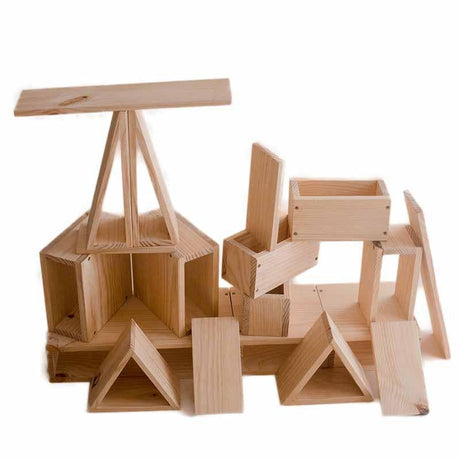
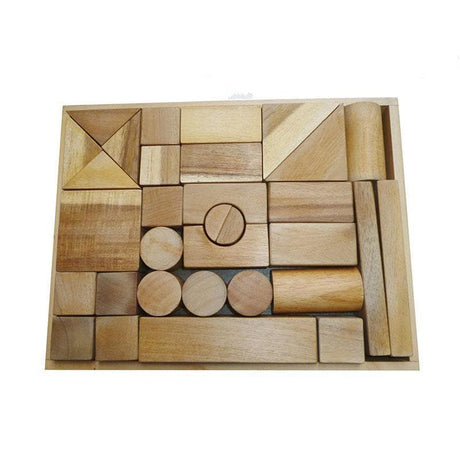
After hundreds of parent reviews, the same qualities separate a great large block set from a frustrating one. Enough variety matters most: sets with long planks, arches, large rectangles, cubes and cylinders let children build far more than just walls — and the arch is consistently the most-loved piece, because one arch becomes a doorway, a bridge, a tunnel, a shop entrance or a stable, reinterpreted endlessly. The blocks also need to be light enough for a child to reposition independently; younger children lose confidence fast if they need an adult to move every piece.

Durability is non-negotiable, because big blocks live a rougher life than small ones — dragged, stacked, sat on and knocked over — so rounded edges and solid construction genuinely matter. Our big blocks are all wooden and built for exactly this kind of play. And compatibility is the quiet winner: large blocks that combine with building boards, stepping stones, loose parts and train tracks stop being a single toy and become part of a much bigger world. You don't need hundreds of pieces, either — enough to build one meaningful structure is the real starting point, because with big blocks it's the size of the pieces, not just the quantity, that changes the play.

Start here

Choosing the Right Big Block Set

It's the size of the pieces, not just the quantity, that changes the play — you need enough to build one meaningful structure, not necessarily hundreds.

Big blocks are the right choice if:

You want builds your child can step inside and play in
Siblings or friends will build together
You'd love a toy that gets children moving, not just sitting

Consider small blocks instead if:

Your child loves detailed, precise, toy-sized building
Space is tight for room-sized constructions
They prefer building objects to building environments
Many families own both — big blocks for inhabitable, cooperative play and small blocks for detail. Look for varied shapes (especially arches and long planks), a manageable weight and durable edges.
Why Families Choose Our Big Block Sets

All wooden, oversized blocks — built to step inside, not just stack

Varied shapes incl. arches & long planks — build places, not just walls

Light enough for children to move, durable enough for rough play

Dispatched from Melbourne — NDIS registered provider

The Questions Parents Actually Ask About Big Blocks

Three questions come up almost every time. "Won't they outgrow them quickly?" — families overwhelmingly report the opposite: the buildings simply become more sophisticated, from a two-year-old's walls to a six-year-old's multi-room villages, so the same set keeps earning its place for years. "Are big blocks worth the extra money?" — the answer is rarely about quality and almost always about longevity: parents describe them becoming part of everyday play rather than a novelty that's exciting once and then forgotten.

"Do you need lots of pieces?" — perhaps the most useful answer of all. Many experienced families say you need enough to build one meaningful structure, not necessarily hundreds, because with big blocks it's the size of the pieces that transforms the play, not sheer quantity. A child stops following pictures, too — large sets rarely come with specific models, and parents who worry "but what do they build?" quickly find the honest answer is "whatever they need." That uncertainty turns out to be freedom, and it's exactly why these sets stay interesting.

Why Parents Really Recommend Big Block Sets

Read enough reviews and one thing becomes clear: parents almost never recommend big block sets because they're educational. They don't say "they learned engineering" or "it improved spatial awareness" — though both are true. They say something simpler and more telling: "my children never seem to run out of ideas," and "it became the centre of the room." Those phrases come back again and again, because once a child builds something they can physically inhabit, the entire style of play changes.

That's the real reason these sets feel so different from ordinary blocks. The construction stops being an object to look at and becomes the setting for everything that follows — the castle a child rules, the café they run, the hospital where every animal gets better. A big block set isn't really a bigger construction toy; it's a toy that says "come inside," and turns a child's ideas into places they can walk into, crawl through and spend a whole afternoon bringing to life. For the wider family of building toys, our building blocks range brings it all together.

Big Blocks: Where Ideas Become Places to Step Into
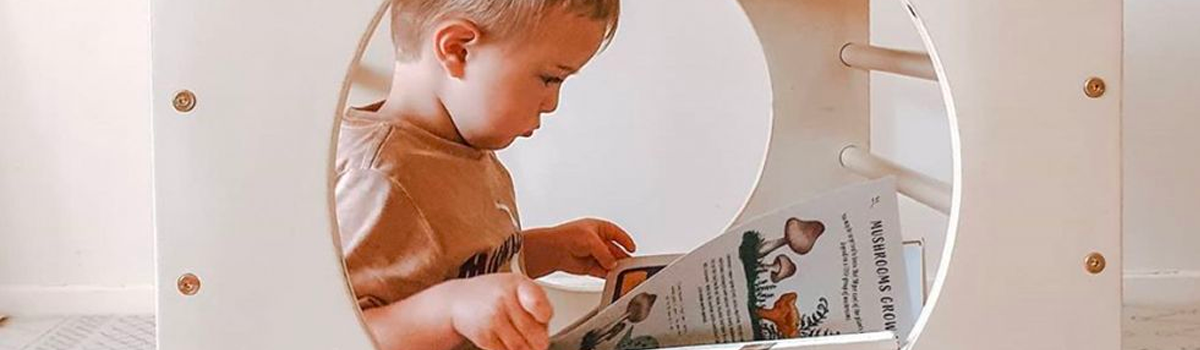
A small-block castle is something a child admires. A big-block castle is somewhere they become the king, the dragon, the shopkeeper or the explorer. That's the quiet magic of large block sets — the child doesn't just create a world, they step into it, and it becomes the centre of the room for days at a time.

Explore the range above, and pair your big blocks with building boards, wooden rainbows, peg dolls and loose parts so the places your child builds can grow as big as their imagination. For the wider family, our building blocks range brings it all together.

Frequently asked questions
Are your big blocks wooden?

Yes — our big block sets are all wooden, made to be dragged, stacked, sat on, built into and rebuilt countless times. We choose them for the qualities that matter in big-block play: varied shapes (including the all-important arches and long planks), a weight that's substantial but still manageable for children to reposition themselves, and durable, rounded, solid construction that stands up to the rougher, whole-body play these sets invite. Specific set contents and any warranty details are listed on each product page.

What makes a great big block set?

Five things: enough variety (long planks, arches, rectangles, cubes, cylinders — so children build more than walls), pieces light enough for a child to move independently (younger children lose confidence if they need help with every block), durable rounded edges and solid construction (big blocks get dragged, stacked and sat on), compatibility with other toys like building boards and loose parts, and open shapes — especially the arch, which becomes a doorway, bridge, tunnel or shop entrance. Our big blocks are all wooden and built for exactly this.

Are big blocks good for siblings or group play?

They're one of the best toys for it. Where smaller construction toys can turn competitive (everyone wanting the same piece), a big build is simply too large for one child to finish alone, so the work naturally divides — one builds walls, another designs entrances, someone becomes the architect. Cooperative building happens without an adult assigning roles, and parents often see different personalities emerge: the planner, the builder, the tester, the storyteller. It's genuinely collaborative play.

How many big blocks do I need?

Fewer than you might think. Many experienced families say you need enough to build one meaningful structure, not necessarily hundreds — because with big blocks it's the size of the pieces, not just the quantity, that transforms the play. Variety matters more than sheer numbers: a set with long planks, arches, large rectangles, cubes and cylinders lets children build places rather than just walls. You can always add more over time as their constructions get more ambitious.

Are big block sets worth the extra money?

Parents overwhelmingly say yes, and the reason is longevity rather than novelty. Big blocks tend to become part of everyday play — constructions stay up for days as children return to evolve them (a castle becomes a vet clinic becomes a neighbourhood), and the same set stays relevant for years. The recurring phrase in reviews isn't about education; it's 'my children never seem to run out of ideas.' A toy that becomes the centre of the room for years earns its cost many times over.

What age are big block sets for?

A wide range, and they grow with the child rather than being outgrown — which surprises parents who worry they'll outgrow them quickly. A two-year-old builds simple walls and enclosures; a six-year-old designs multi-room villages and connected communities. The same set simply becomes more sophisticated over time. Big blocks also suit a lovely span of gross-motor play, getting children lifting, carrying and climbing around their builds. Always check the recommended age on each set.

What can children build with big blocks?

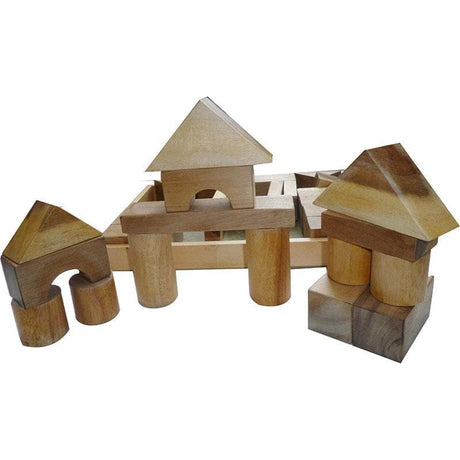
Far more than tall towers. Because the pieces are child-sized, children build places they can inhabit — castles, cubbies, cafés, hospitals, airports, train stations, race tracks, even whole neighbourhoods with streets, parks and shops. The play continues inside the build rather than ending when it's finished: children sit inside, crawl through, serve food from it and defend it. Large sets rarely come with set models, so the honest answer to 'what do they build?' is 'whatever they need.'

What's the difference between big blocks and small blocks?

The simplest way to put it: small blocks build objects, big blocks build environments. Small wooden blocks are made for toy-sized worlds — precise, detailed builds that often become scenery for other play. Big blocks are made for child-sized worlds — structures a child can step inside, crawl through and play in. The buildings stop being something to look at and become the setting for the whole game. Many families own both, because they satisfy different creative instincts.