Click & Collect or 24hr Dispatch*

Open-Ended Play Guide

Not All Wooden Toys Are Created Equal

Walk through almost any toy store, browse an online marketplace or spend a few minutes scrolling social media and you'll quickly notice a pattern. Wooden toys are everywhere.

For many parents, wooden has become shorthand for quality, safety and thoughtful design.

But wood is a material. Not a safety standard. Not a quality guarantee. And not a design philosophy.

11 minute read Updated 2026 By My Happy Helpers
"Wood is a material. Not a safety standard. Not a quality guarantee."

The Wooden Toy Boom

Over the last decade, wooden toys have experienced a remarkable resurgence. As families have become increasingly interested in open-ended play, Montessori-inspired learning and natural materials, demand for wooden toys has grown dramatically.

In many ways, this has been a positive development. There are now more thoughtfully designed toys available than ever before. Parents have greater access to products that encourage creativity, problem-solving and child-led exploration. But growing demand has also created a challenge.

As the category expands, more businesses enter the market. Some are deeply invested in childhood development, product design and safety. Others simply recognise that wooden toys are popular.

The result is a marketplace where products can appear remarkably similar while differing significantly in quality, durability, safety and play value.

And that's where things become interesting. Because some of the most important differences are almost impossible to see in a product photo.

Why "Wooden" Is Not A Safety Standard

One of the most important things parents can understand is that wood itself tells us very little about a toy. A wooden toy can be exceptionally safe. A wooden toy can also be poorly designed. The material alone doesn't tell the story. What matters is how the toy has been developed, tested and manufactured.

When assessing a children's product, we encourage parents to look beyond the material and ask deeper questions. Has it been tested? Does it comply with recognised safety standards? Was it designed for a specific developmental stage? Can the company explain why particular materials and dimensions were chosen? Can they explain the thinking behind the design?

These questions often reveal far more than a product description ever will.

The Manufacturing Conversation Most Parents Never Hear

One of the unexpected things we've learned while developing children's products is how easy it is for consumers to assume quality can be seen. In reality, some of the most important decisions happen long before a toy is photographed, packaged or placed on a shelf.

We've sat with production teams discussing timber selection. We've reviewed multiple versions of the same product. Compared prototypes. Rejected samples. Requested modifications. Tested finishes. Changed materials. Repeated the process again. And one thing became very clear.

Many of the decisions that determine quality are invisible to the customer.

A beautifully styled product image can tell you what a toy looks like. It rarely tells you how it was made. It doesn't tell you how many prototypes were tested. It doesn't tell you why one timber was chosen over another.

It doesn't tell you whether a finish was selected because it was the cheapest option or because it created the best experience for the child.

Those conversations happen behind the scenes. Yet they often have a greater influence on quality than anything visible in the final product. This is one of the reasons we encourage parents to look beyond marketing language.

The most valuable questions are often the ones that aren't answered in the product photos.

Peg People of the World

Understanding Toy Safety Standards

One of the strongest indicators of a thoughtfully developed toy is compliance with recognised safety standards. Parents often see terms such as CE, EN71 or Australian/New Zealand standards without fully understanding what they mean. While the technical details can be complex, the principle is straightforward. These standards exist to help assess whether products are suitable for children's use.

Depending on the product, testing may examine areas such as:

  • Physical safety
  • Mechanical integrity
  • Small parts
  • Material safety
  • Chemical requirements
  • Surface coatings and finishes

At My Happy Helpers, compliance with CE, EN71 and Australian/New Zealand standards forms an important part of our product development process. Not because testing is a marketing feature.

Because children's products should be able to demonstrate their safety, not simply claim it.

What We Look For When Visiting A Factory

One of the biggest surprises for many parents is how much of a toy's quality is determined long before the finished product exists. Over the years, we've visited factories and worked closely with manufacturing teams across multiple product categories.

When we walk through a facility, we're not simply looking at finished products. We're looking at the processes behind them.

We pay attention to:

  • Timber sourcing
  • Moisture content
  • Consistency between production batches
  • Sanding quality
  • Edge finishing
  • Surface treatments
  • Quality control procedures
  • Safety documentation

A toy can look beautiful in a photograph while hiding shortcuts in production. Conversely, some of the best-made products reveal their quality through details most consumers never consciously notice. The smoothness of an edge. The consistency of a finish. The way pieces fit together.

The way a toy feels after years of use rather than weeks. These are the details that matter.

Euca Rainbow

Why Timber Choice Matters

Spend enough time researching wooden toys and you'll eventually encounter discussions about timber species. Beech. Lime wood. Linden wood. Birch. Maple. Hardwood. Softwood.

The conversation often becomes focused on identifying the "best" timber. We used to think that was the right question too. Then we started spending time with manufacturers, educators and children. The more we learned, the more complicated the answer became.

Different timbers create different experiences.

Different weights. Different textures. Different levels of grip. Different balancing characteristics. The most suitable timber isn't necessarily the hardest or most expensive. It's the one that best supports the purpose of the toy.

Why We Use Both Lime Wood And Beech

One question we're frequently asked is why some of our open-ended toys use lime wood while others use beech. The answer is simple. Different toys place different demands on a material.

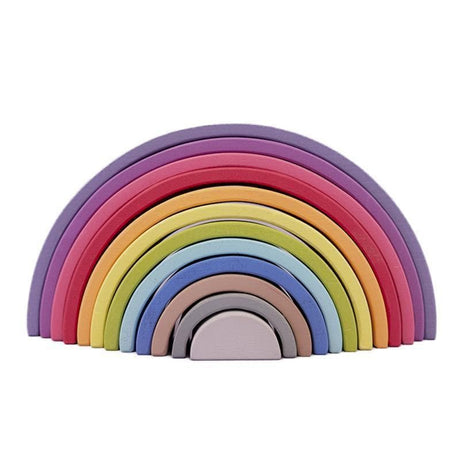
For many rainbow stackers, stepped blocks and open-ended construction toys, we love working with lime wood. Lime wood offers a beautiful tactile experience. It is lightweight, comfortable to hold and naturally grippy, making it particularly enjoyable for stacking, balancing and imaginative building. Children may never consciously identify those characteristics. But they notice them through play.

Children notice how pieces balance. How they stack. How they feel. How they respond.

Other products benefit from the increased density and durability of beech wood. Rather than choosing a single timber for every product, we select materials based on the intended play experience. The decision begins with the child. Not the specification sheet.

Why Harder Doesn't Always Mean Better

One of the biggest misconceptions in the wooden toy industry is the idea that harder automatically means better. Harder timbers can absolutely offer advantages. They often resist dents more effectively and provide excellent durability. But durability is only one part of the equation.

Over the years, we've learned that children's interaction with a toy is influenced by many factors:

  • Weight
  • Balance
  • Grip
  • Texture
  • Handling
  • Tactile feedback

A timber that performs beautifully in one product may not be ideal in another. The goal isn't to find the hardest wood available.

The goal is to create the best possible experience for the child using it.

Paint, Dye And Surface Finishes

Another area where products can differ significantly is in their finish. Many parents assume coloured wooden toys are all finished in the same way.

They are not.

Some products are painted. Others are dyed. Some use opaque finishes. Others allow the natural grain to remain visible. Each approach creates a different visual and tactile experience. One of the reasons dyed wooden toys have become so popular within open-ended play is that they celebrate the natural character of the timber itself.

The grain remains visible. The texture remains present. The material continues to feel like wood.

At My Happy Helpers, many of our open-ended products use hand-finished dyes because we love the way they preserve the natural beauty of the timber while allowing colour to remain part of the play experience.

The Difference Between Quality And Play Value

One of the most valuable lessons we've learned at My Happy Helpers is that quality and play value are related, but they are not the same thing. A toy should absolutely be safe. It should be durable. It should feel beautiful in a child's hands. It should be made from materials selected for purpose. Those qualities matter.

But they don't automatically create engagement. Children don't return to a toy because it passed laboratory testing. They don't fall in love with it because it complies with a safety standard.

They return to it because it sparks ideas. Because it supports exploration. Because it becomes something new every time they pick it up.

The best toys bring both worlds together. Thoughtful design. Careful manufacturing. Rigorous safety standards. And genuine opportunities for creativity.

In our experience, that balance is where exceptional toys are found.

The Questions Every Parent Should Ask

After years spent developing children's products, there are a handful of questions we believe every parent should feel comfortable asking.

  • What safety standards does this product comply with?
  • Why was this material chosen?
  • How has the toy been finished?
  • What age range was it designed for?
  • How does it support play?
  • Can the company explain the design decisions behind the product?

Businesses that genuinely understand children's products should be able to answer those questions clearly. Because good design is rarely accidental. It is intentional.

The Difference Between A Toy And A Well-Designed Toy

When parents first begin researching wooden toys, it's easy to focus on appearance. The colour. The timber. The photographs. The brand. Over time, however, most families discover that the most important qualities are often the least visible.

Safety. Thoughtful design. Materials chosen for purpose. Developmental suitability. Durability. Play value.

These are the details that determine whether a toy becomes part of childhood for a few weeks or for many years. Because ultimately, the best wooden toys are not defined by the timber alone. They are defined by the thinking behind them.

And that is why not all wooden toys are created equal.

Explore

Open-Ended Play

}