Click & Collect or 24hr Dispatch*

Build & Construct · Open-Ended Play

Wooden Rainbows & Rainbow Stackers

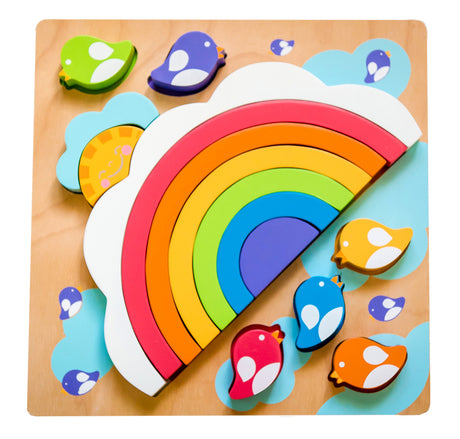
Most parents first see a wooden rainbow as a colourful stacking puzzle. The children who play with them for years almost never use them that way. They use them as architecture — the bridges, tunnels, houses, mountains and birthday cakes that the rest of their imaginative play happens inside. A wooden rainbow's real magic isn't its shape; it's its lack of any fixed identity.


A Wooden Rainbow Is Architecture, Not a Puzzle

When a wooden rainbow arrives, most parents expect their child to stack the arches into a rainbow, admire it, and move on. What actually happens — and keeps happening for years — is something different. The arches become a doll house in the morning, a row of animal stables after lunch, a birthday cake in the afternoon and the roof of a dinosaur cave by bedtime. The same pieces, a completely different world each time. Children stop seeing colours and start seeing buildings, landscapes and furniture.

That's the insight worth understanding before you buy: a wooden rainbow's value isn't in how it looks on the shelf, it's in how little it dictates. A toy kitchen is always a kitchen; a toy garage is always a garage. A wooden rainbow is a bridge before morning tea and a mountain by bedtime, because it quietly adapts to whatever story your child is already telling. That open-endedness is exactly why families describe it as one of the few toys that keeps reappearing in different games for years rather than being outgrown — and why it pairs so naturally with peg dolls, play silks, wooden blocks and loose parts.

Wooden Rainbows Rainbow Stackers Bridges, Tunnels & Houses Grows With Your Child

When the Wooden Rainbow Becomes a House That Changes Daily

Ask a parent who's owned a wooden rainbow for a while and the doll house comes up again and again. The arches become bedrooms, a kitchen, bunk beds, a balcony, a dining table — a whole home your child furnishes and moves peg dolls into. Then the next day, with no new toy required, the exact same arches are pirate-ship cabins, dinosaur caves, fairy houses or castle towers. The rainbow isn't the toy your child plays with; it's the building their story happens inside.

Close behind is the animal rescue centre: arches become horse stables, dog kennels, bird nests, burrows and zoo enclosures, and suddenly every animal has somewhere to belong. Children spend ages deciding who lives together, who escaped, which baby needs its mum — and the storytelling runs far longer than the building did. Add a few more arches and the play grows into a whole town: a bakery, a hospital, a school, a café, with peg people visiting each one. This is why the rainbow rarely stays a 'rainbow' for long — it becomes the framework a child's whole imagined world is built on.

When the Rainbow Stacker Becomes Tunnels, Bridges and Mountains

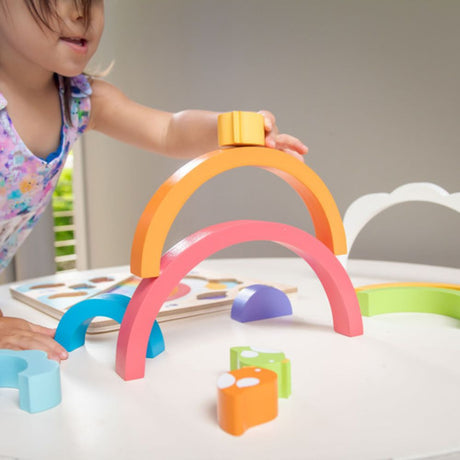
The most universal use parents describe is the tunnel. Children line every arch up, and cars, trains and dinosaurs disappear through one after another — then they connect another tunnel, and another, until it stretches across the whole lounge room. Flip a single arch upside down and it's an instant bridge, which immediately creates a reason to invent rivers, lakes, roads and cliffs around it. The structure poses a question — how do we get across? — and the world expands to answer it.

Stand the arches up and they stop being colours and start being landscape: mountains, rolling hills, ski slopes, volcanoes. Dinosaurs and goats climb them, cars race down them, peg people camp on top. Some children naturally turn them into marble runs — one arch a slope, another a support — rolling balls and pom poms through and asking which path works best, often extending the play with building boards. And colour learning happens without anyone teaching it: "the red family lives here," "the blue car goes through this tunnel." The colours gain meaning because they matter inside the story, which is how the learning actually sticks.

Why Our Wooden Rainbows Are Built to Be Built With

Here's where most retailers compare colours and miss what matters: a wooden rainbow lives or dies on whether children can actually build with it. If the curves aren't smooth and consistent, bridges wobble and tunnels won't line up — and children notice long before adults do. If the timber's too thin it looks pretty but tips over; too heavy and a toddler can't reposition it alone. So we choose our rainbows for play value, not just looks.

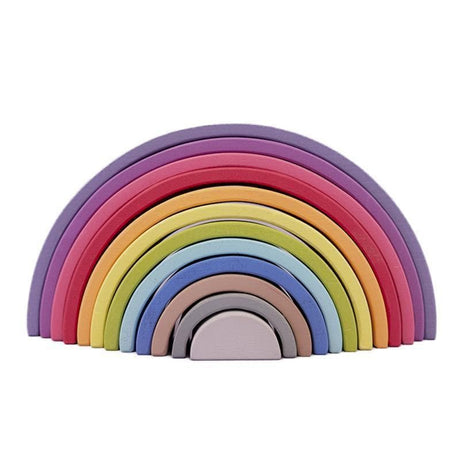
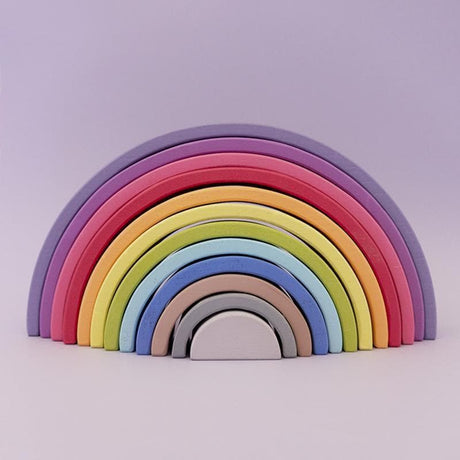
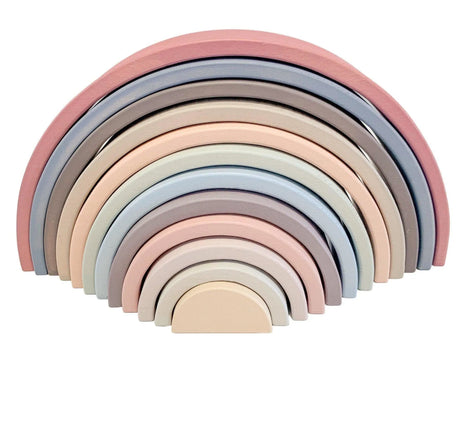
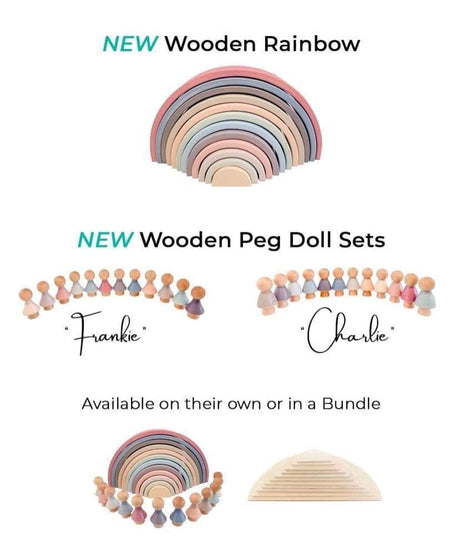
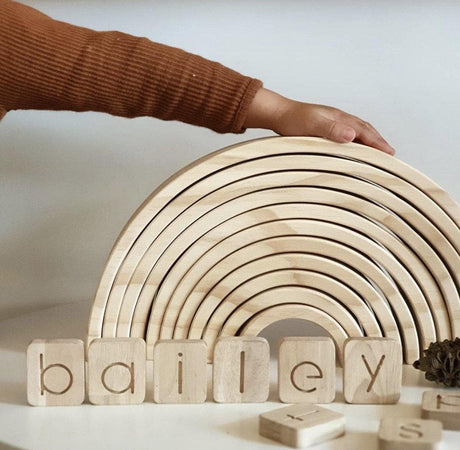
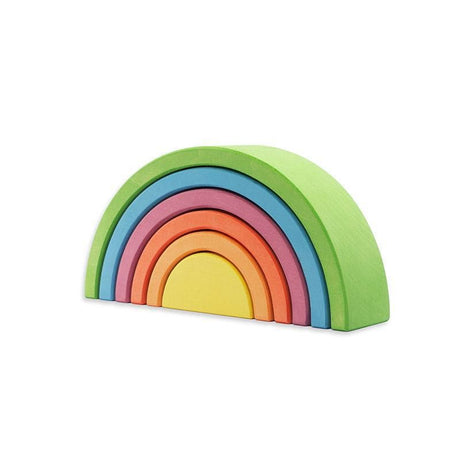
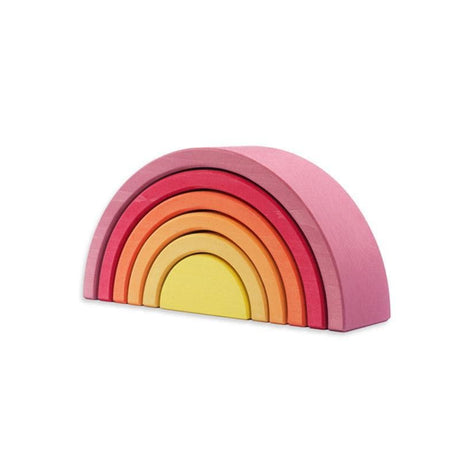
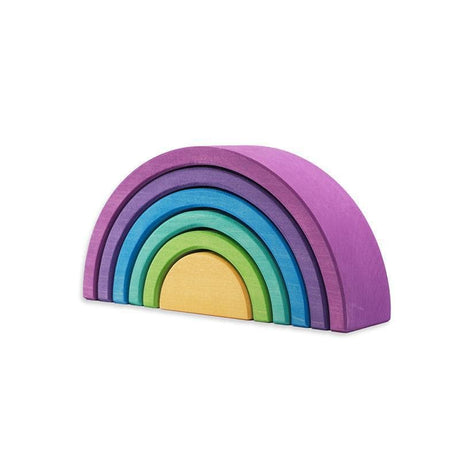
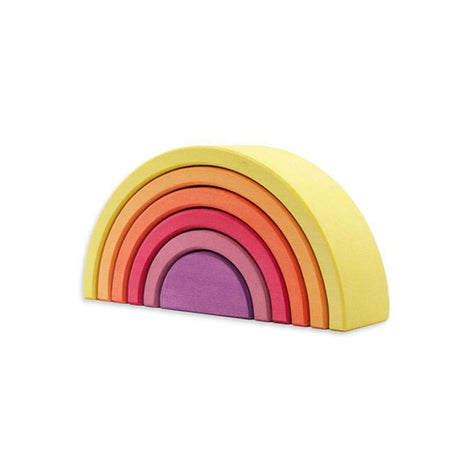
That starts with the timber, chosen specifically for stackability. Our Harmony rainbow uses beech wood; several of our other rainbows use Linden, picked for being lightweight enough for small hands to lift and grippy enough to stack confidently without sliding. We curate across our own MHH range alongside brands we rate like Qtoys and Ocamara, in a variety of sizes and palettes — from bright to soft pastel and natural. On palette, we've come round to what parents tell us: softer, more natural tones often blend into imaginative worlds more easily, because the child stops thinking 'the red piece' and starts thinking 'the bridge' or 'the cave'. The colours support the story instead of becoming the focus.

The Wooden Rainbow That Disappears Into Every Other Toy

One of the truest things parents say about wooden rainbows is that children rarely play with them on their own. Instead, the rainbow becomes part of everything else they already own. It joins the wooden blocks as part of a bigger build, arches over a play silk river, shelters the peg dolls and animal figures, becomes scenery for loose parts landscapes, or the tunnels for a train set. It's one of those toys that keeps reappearing in different games rather than being the main event.

That's worth knowing if you're weighing up whether it's worth it. A wooden rainbow isn't a single-purpose toy you'll rotate out in a few months — it's connective tissue for a whole playroom, the piece that quietly makes other toys more interesting. Parents who expected a stacking puzzle are often surprised that it becomes one of the most-reached-for things their child owns, precisely because it never insists on being any one thing.

The Same Wooden Rainbow Grows With Your Child

Few toys span as many ages as a wooden rainbow, and parents describe the progression clearly. An 18-month-old stacks it, knocks it down, and carries the arches around — simple, satisfying, and exactly right for that age. A three-year-old builds tunnels, bridges and houses with it. A five-year-old uses it as scenery inside elaborate small-world stories, the arches becoming caves and mountains in adventures that fill an afternoon.

And it genuinely doesn't stop there. In parent discussions, children of seven, eight, even eleven still pull the rainbow into their play — building towns, train layouts and imagined worlds. That's the return on an open-ended toy: it isn't outgrown when a developmental stage passes, because there's always a more sophisticated way to use it. One wooden rainbow can reasonably be in regular play for the better part of a decade, which is rare enough to be worth saying plainly.

Start here

Choosing the Right Wooden Rainbow

Look at play value, not just colour — the best wooden rainbow is the one your child can actually build with.

Consider a smaller rainbow if:

It's for a younger toddler stacking and carrying
You want a first open-ended toy to add to
Smaller hands need lightweight, easy-to-grip arches

Consider a larger rainbow if:

They already build tunnels, towns and small worlds
You want more arches for bigger structures
It's shared between siblings building together
Whatever the size, prioritise smooth consistent curves and a good weight — that's what lets children build confidently, and it's what we select our rainbows for.

Why Families Choose Our Wooden Rainbows

Timber chosen for stackability — beech & Linden, built to build with

Curated range: MHH own-brand plus Qtoys & Ocamara

A variety of sizes and palettes — bright, pastel and natural

Dispatched from Melbourne — NDIS registered provider

What to Look For in a Wooden Rainbow

Most buying guides tell you to compare colours. After years of these passing through families, we'd tell you to compare play value instead — because a wooden rainbow that's hard to build with gets abandoned, however pretty it looks.

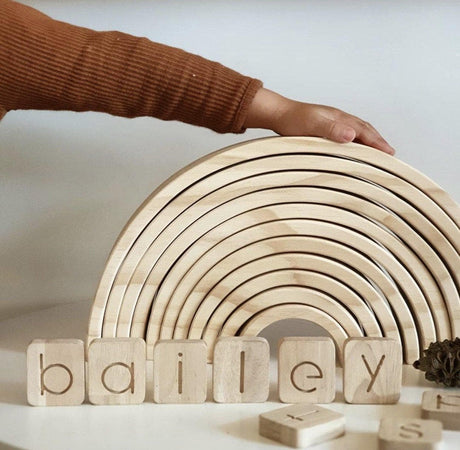
Smooth, consistent curves matter most: if the arches aren't evenly shaped, bridges wobble and tunnels won't line up, and children notice and lose patience long before adults would. The timber needs to be thick enough to build with confidently — very thin rainbows look lovely but tip over and feel more decorative than functional — without being so heavy a toddler can't reposition the arches independently. A smooth satin finish should feel pleasant but keep enough grip that pieces don't simply slide away, and a finish that lets the natural grain show tends to age most gracefully through years of cars and animals being run across it. These are the things we actually select our rainbows against, which is why our timber is chosen for stackability rather than just appearance.

A Wooden Rainbow Grows With Your Child — and Brings Them Together

Part of what makes a wooden rainbow such good value is how long it stays in play. The same set serves an 18-month-old stacking and toppling, a three-year-old building tunnels and houses, and a five-year-old creating scenery for elaborate small-world stories — and parents regularly describe children of seven, eight, even eleven still pulling it into towns and train layouts. Because the play is open-ended, it isn't outgrown when a stage passes; there's always a more sophisticated way to use it.

It's also one of the better toys for children playing together, which matters in households with more than one child. A wooden rainbow invites collaborative building rather than turn-taking: one child builds the structure, another imagines the story, a third moves the animals through it. Nobody has to wait for a turn, because everyone can contribute something different to the same world. Pair it with building boards and the shared builds get bigger and more ambitious — bridges, marble runs and multi-level towns that two children will happily lose an afternoon to.

One Wooden Rainbow, Endless Worlds

A wooden rainbow is a bridge before morning tea, a stable after lunch, a birthday cake in the afternoon and the roof of a dinosaur cave tomorrow. It doesn't tell your child what to imagine — it quietly becomes whatever the story needs. That's what makes it feel timeless rather than trendy, and why families keep coming back to it for years.

Explore the range above and choose for play value first, then pair it with peg dolls, play silks, building boards and loose parts so the worlds your child builds can grow as far as their imagination takes them.

Frequently asked questions
What toys go well with a wooden rainbow?

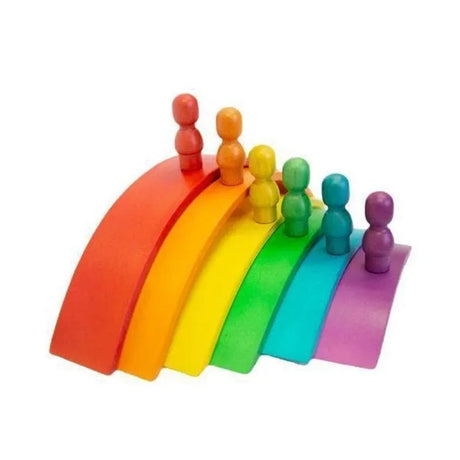
A wooden rainbow pairs with almost everything open-ended. It's a natural partner for peg dolls and animals (the arches become homes and habitats), play silks (rivers and landscapes), wooden blocks (bigger builds), building boards (bridges, ramps and marble runs) and loose parts of all kinds. Many families find the rainbow becomes the connective piece that ties their other open-ended toys together into one world.

Do bright or pastel wooden rainbows work better?

Both are lovely, but it's worth knowing what many parents report: softer, more natural palettes often blend into imaginative play more easily, because the child stops thinking about 'the red piece' and starts thinking about 'the bridge' or 'the cave'. Brighter rainbows are visually striking and great for colour play. Neither is better outright — it depends whether you want the colours to support the story or to be part of the play themselves.

Do wooden rainbows help children learn?

Yes, though rarely through deliberate teaching. Colour recognition happens naturally because the colours gain meaning inside the story ('the blue car goes through this tunnel'). Building bridges, tunnels and balanced structures develops spatial reasoning, planning and an intuitive feel for balance; turning arches into marble runs explores slopes and motion; and the open-ended storytelling builds language, sequencing and cooperation. The learning happens because the child is absorbed in play they chose.

What are your wooden rainbows made from?

It varies by rainbow, and the timber is chosen specifically for stackability. Our Harmony rainbow uses beech wood; several of our other rainbows use Linden, chosen for being lightweight enough for small hands and grippy enough to stack confidently. We curate across our own MHH range alongside brands we rate, including Qtoys and Ocamara, in a range of sizes and palettes. Each product page lists its specifics.

What should I look for in a good wooden rainbow?

Look at play value, not just colour. Smooth, consistent curves matter most — uneven arches mean wobbly bridges and tunnels that won't line up, and children notice. The timber should be thick enough to build with confidently without being too heavy for small hands to reposition. A smooth satin finish that keeps some grip (so pieces don't slide) and lets the grain show ages best. We select our rainbows against exactly these criteria rather than for looks alone.

Are wooden rainbows worth it?

In our experience they're one of the best-value open-ended toys you can buy, precisely because they're so rarely played with in isolation. A wooden rainbow becomes part of everything else — block builds, peg doll worlds, train tunnels, play silk landscapes — and keeps reappearing in new games for years. A toy that stays in regular play from toddlerhood into primary school earns its place many times over.

What age is a wooden rainbow for?

One of the widest age ranges of any toy. An 18-month-old stacks, topples and carries the arches; a three-year-old builds tunnels, bridges and houses; a five-year-old uses them as scenery in elaborate small-world play. Many children keep using them well into primary school for towns, train layouts and imagined worlds. Because the play is open-ended, the same rainbow keeps being useful for years rather than being outgrown.

What's the difference between a wooden rainbow and a rainbow stacker?

They're the same toy — 'wooden rainbow' and 'rainbow stacker' (or 'wooden rainbow stacker') are used interchangeably for the set of nested wooden arches. The 'stacker' name comes from the most obvious first use, but as most families discover, stacking is only the beginning of what children actually do with them.

What is a wooden rainbow used for?

Far more than stacking. While younger toddlers enjoy stacking and knocking down a wooden rainbow, the children who play with them for years use them as architecture — bridges, tunnels, houses, animal stables, mountains, birthday cakes and shop counters. The arches become the buildings and landscapes that the rest of their imaginative play happens inside, which is why a wooden rainbow rarely stays a 'rainbow' for long.